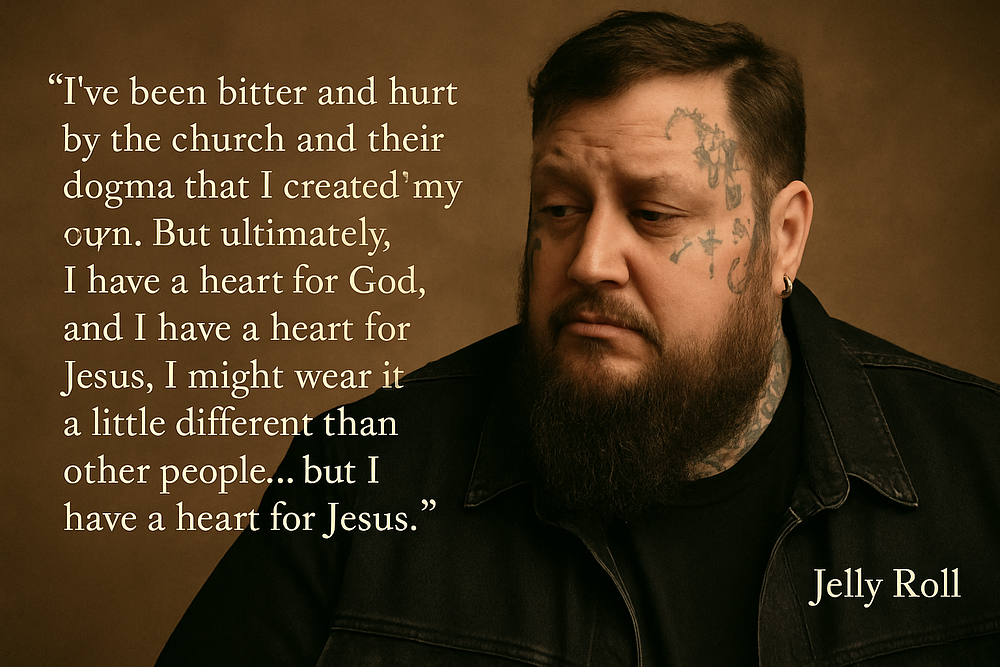
There’s something about a man with a cross tattooed under his eye, standing on 100 acres of Tennessee land, pointing across a creek and saying, “That’s where we’re gonna save lives.”
Jason DeFord — known to the world as Jelly Roll — isn’t your typical philanthropist. He’s not a Silicon Valley billionaire writing checks from a distance. He’s not a celebrity doing charity for the photo op. He’s a man who spent his teenage years and most of his twenties cycling in and out of prison cells. A man who dealt drugs, robbed people, and knew the inside of a jail better than he knew freedom.
And now? Now he’s building something that could change everything for people like him. For people like us.
The Damascus Road Moment in a Prison Cell
May 22, 2008. Jelly Roll was 23 years old, locked up for drug dealing, when a guard knocked on his cell door midafternoon.
“DeFord, you had a kid today.”
“What?”
“Yeah, you had a child.”
“What’s her name?”
“Hell, I don’t know.”
That was it. That was the moment. Jelly Roll calls it his “Damascus Road experience” — referencing the Biblical story of Saul (who became Paul) having his life completely redirected by an encounter with God. In that prison cell, something shifted. His daughter Bailee Ann had been born, and suddenly the life he’d been living wasn’t just about him anymore.
“I’ve never had anything in life that urged me in the moment to know that I had to do something different,” he told Billboard. “I have to figure this out right now.”
While still serving time, he studied for and passed his GED on the first try. When he got out, he met his daughter at her second birthday party. He grilled hamburgers and hot dogs. And he made a decision: “I had to get rid of the lean, the pills, the cocaine. I didn’t have a choice. It was me or them, and I had to learn to love myself.”
Why me Lord — I hear his voice
silent your heavy emotion evil desire preys on the flesh
The Church That Remembered Him
Here’s where it gets beautiful in that unexplainable, only-God-could-orchestrate-this way.
When Jelly Roll’s teenage daughter Bailee wanted to be baptized, she asked her dad to come to church with her. He was 39 years old. “I should go see what kind of cult she’s going to,” he remembered thinking, “because that’s kind of how I looked at church at that time.”
But when he walked into that small back-road church, something happened. He was reminded “of the genuineness that can be in those walls.” And then — get this — the church reached out to him. They’d found his records. At 14 years old, before everything went wrong, Jason DeFord had filled out a card asking to be baptized at Whitsitt Chapel Baptist Church in Antioch, Tennessee.
They’d kept that card for 24 years.
“It restored my faith in stuff,” Jelly Roll said. That church — the one that baptized him before he went to prison, before the drugs, before the pain — they never forgot him. And when he returned, broken and famous and searching, they welcomed him home.
He named his breakthrough country album after that church: Whitsitt Chapel.
“I got baptized in here some 20 years ago and have since done nothing but go to prison, treat a bunch of people wrong, make a lot of mistakes in life, turn it around, then go on to be a multimillionaire and help as many people as I possibly can,” he said.
A Heart for Jesus Wearing It Different
Jelly Roll doesn’t fit the Christian celebrity mold. He’ll tell you that himself.
“I have been so bitter and hurt by the church and their dogma that I created my own,” he admitted. But when he collaborated with worship leader Brandon Lake on “Hard Fought Hallelujah,” something broke open. The song won Song of the Year at the 2025 Dove Awards — Christian music’s biggest honor.
When Jelly Roll stood at that podium to accept the award, tattooed and emotional, he said something that should challenge every one of us who calls ourselves believers:
“Y’all forgive me…I’m nervous. But I’m here because people visited the least.”
Think about that. He’s standing in a room full of Christian music’s elite, and he’s reminding them — reminding us — that Jesus spent His time with tax collectors, prostitutes, and prisoners. The least. The last. The lost.
“I have a heart for God, and I have a heart for Jesus,” Jelly Roll declared. “I might wear it a little different than other people. I might say things that other Christians don’t think are right to say. But ultimately, I have a heart for God.”
One Christian blogger put it perfectly: “If you can say Jelly isn’t a Christian, then you have to say David, Moses, Peter, and Paul were all not Christians. Would you say that? Of course you wouldn’t, but who of them was perfect?”
At his father’s funeral, people came from both the church and the bar. “Wouldn’t it be cool to be that guy?” Jelly Roll said. “Someone so loved at a bar and so loved at a church.”
That’s the kind of Christianity that changes the world. The kind that doesn’t require you to clean up before you show up. The kind that meets you in your mess and walks with you toward redemption.
100 Acres of Second Chances
Now let’s talk about what he’s building.
On Jelly Roll’s sprawling Tennessee property — about 1,000 acres total — there’s a creek. And on the other side of that creek, 100 untouched acres are about to become a sanctuary for the broken.
Completely free.
A 100-acre rehabilitation and mental health campus where “poor kids, down bad, when life was kicking our ass” can find the help they need. Not just a 28-day program. Not just 12 steps. But something holistic:
- Traditional 12-step recovery programs
- Intensive mental health therapy
- Holistic approaches to healing
- Nutritional support and education
- On-site medical care
- “Guest weekenders” — people who’ve battled addiction themselves coming to spend time with those in treatment, not as speakers on a stage, but getting “in the mud with the boys”
“Imagine drug addicts like you and like us, poor kids, like we’re just down, when life was kicking our ass,” Jelly Roll explained to his friend Mike Majlak (himself a recovery advocate). “And now think about the resources that we have that could have helped us so much in those moments.”
This isn’t a pipe dream. This isn’t a celebrity talking point. When Jelly Roll revealed the plan to Majlak, his friend — who battled heroin and opioid addiction for eight years — was visibly moved: “I’m in. Whatever you need — I’m there.”
“We went through hell so a lot of people might not have to,” Majlak said.
The Spirit Speaking Through Scars
Here’s what gets me about this whole thing — what makes my spirit recognize the fingerprints of God all over it:
Jelly Roll is building exactly what he needed when he was 14, 17, 23. He’s not theorizing about addiction from a textbook. He’s not guessing about what works. He lived it. He knows the shame, the stigma, the way society throws you away when you’re an addict. The way even churches can make you feel like you’re too far gone.
“Could you imagine the national media attention it would get if they were reporting that a plane was crashing every single day and killing 190 people?” he asked when testifying before the U.S. Senate in 2024. “But because it’s 190 drug addicts, we don’t feel that way. Because America has been known to bully and shame drug addicts, instead of dealing and trying to understand what the actual root of the problem is.”
In January 2024, Jelly Roll stood before the Senate Banking, Housing, and Urban Affairs Committee — this former drug dealer, this convicted felon who can’t even vote — and lobbied for the FEND Off Fentanyl Act. He told them about carrying caskets of people he loved. He told them about attending more funerals than he cares to count.
“I was a part of the problem,” he testified. “I am here now, standing as a man that wants to be a part of the solution.”
That’s what redemption looks like. Not perfection. Not a sanitized testimony with all the rough edges filed off. But a man who says, “I brought my community down. I hurt people. I was the uneducated man in the kitchen playing chemist with drugs I knew absolutely nothing about” — and then uses his platform, his resources, his life to turn that pain into purpose.
The Gospel for Sinners
There’s a line in Jelly Roll’s music that captures this whole thing: “worship music for sinners.”
When he first heard Brandon Lake’s “Hard Fought Hallelujah,” he didn’t even realize it was a Christian song. “I haven’t had a record touch me like that in so long,” he said. “To me, it was like, worship music for sinners.”
Isn’t that what the Gospel actually is?
When God Shows Up in Your Car Radio
I need to tell you something personal here, because this is where Jelly Roll’s music stops being about faith and becomes a vessel for it.
Every single time I leave my house in tears — and if you know anything about life, you know those moments come — every single time I get in my car broken and hurting, God has Jelly Roll’s songs waiting for me on the radio. I’m not exaggerating. It’s happened so many times now that it can’t be coincidence.
And instantly — instantly — I’m reminded who I belong to.
I’m reminded that I’m free no matter what life throws at me or what I take to myself. Jesus is there. He knows my hurt. He has experienced all the pain mankind can throw at us in one day. Every bit of it. The betrayal, the shame, the physical agony, the abandonment, the mockery, the loneliness of suffering while the world looks away.
He’s been there. And somehow, through this tattooed country singer from Antioch who spent most of his twenties in prison, God reminds me of that truth when I need it most.
That’s what I mean when I talk about the Spirit speaking through unlikely vessels. That’s what happens when God uses the broken to minister to the broken. We recognize each other. We know the language. We don’t need the religious polish because we’ve already been stripped down to nothing.
And in that nothing? That’s where Jesus meets us.
Jesus didn’t come for the righteous. He came for the sick. He came for the ones who knew they needed a Savior because they’d tried everything else and failed. He came for the woman at the well who’d had five husbands. The woman caught in adultery. The thief on the cross who had nothing to offer but “remember me.”
Jelly Roll gets that in a way that makes a lot of comfortable Christians squirm.
“I only talk to God when I need a favor,” he sings in “Need a Favor.” “And I only pray when I ain’t got a prayer. So who the hell am I to expect a savior when I only talk to God if I need a favor?”
That’s the kind of honesty that cuts through all the religious performance. That’s the kind of self-awareness that actually opens the door to real transformation.
Why This Matters for All of Us
If you’ve never struggled with addiction, you might think this story doesn’t apply to you. But here’s the truth: we’re all addicts of some kind.
Some of us are addicted to control. To approval. To numbing our pain with work, food, shopping, scrolling. To maintaining an image while dying inside. To religious performance while our hearts are far from God.
The spirit that drives addiction is the same spirit that drives all sin: the desperate attempt to fill a God-shaped hole with anything but God.
And the spirit that drives recovery? That’s the same Spirit that drives all true transformation: the Holy Spirit meeting us in our brokenness and whispering, “You don’t have to stay here. There’s a better way. Let Me show you.”
Jelly Roll’s 100-acre campus isn’t just about drug addiction. It’s about creating a space where broken people can encounter the God who specializes in putting broken things back together.
It’s about saying to the world: “The least of these? They matter. Their lives have value. Their recovery matters. And we’re going to prove it by investing in them when nobody else will.”
The Hard-Fought Hallelujah
At the 2025 Dove Awards, Brandon Lake publicly apologized on behalf of the Church: “I want to apologize on behalf of the church and Christians that have hurt you, misunderstood you, not given you grace.”
That moment — that recognition that the Church has often wounded the very people Jesus came to save — that’s what makes Jelly Roll’s story so powerful.
He’s not pretending the Church is perfect. He’s not sanitizing his story to make Christians comfortable. He’s being honest about the hurt, the dogma, the judgment. And yet — and yet — he’s still declaring, “I have a heart for Jesus.”
That’s what a hard-fought hallelujah sounds like. It’s praise that rises from the ashes. Worship that claws its way out of the pit. Faith that refuses to die even when everything around it is broken.
“Faith is not for the flawless,” someone wrote about the Jelly Roll and Brandon Lake collaboration. “It’s for the fighters.”
Building the Help You Never Had
“Now that I have the resources,” Jelly Roll said, “I want to be the help I never had.”
There it is. The whole mission statement in one sentence.
He’s not building this campus because he has all the answers. He’s building it because he knows what it’s like to have no answers, no help, no hope. He knows what it’s like to be written off, locked up, and left behind.
And now? Now he’s saying to everyone who’s been where he was: “You matter. Your life matters. Your recovery matters. And I’m going to prove it by building you a place where you can heal — for free.”
That 100 acres on the other side of the creek? That’s what grace looks like when it puts on work boots and gets its hands dirty.
That’s what happens when the broken decide to build sanctuaries instead of giving up.
That’s what happens when someone who’s been to hell and back says, “I’m going to make sure nobody else has to walk that road alone.”
The Invitation
Jelly Roll’s story — from that prison cell to the Senate floor to 100 acres of hope — is a reminder that God doesn’t just tolerate our brokenness. He uses it.
Your past doesn’t disqualify you. Your mistakes don’t make you unredeemable. Your addiction, your incarceration, your shame — none of it is too much for God to work with.
In fact, it might be exactly what He wants to use to change the world.
Because who better to reach the broken than someone who’s been broken and put back together?
Who better to build a sanctuary than someone who knows what it’s like to desperately need one?
Who better to sing a hallelujah than someone who had to fight for every note?
Jelly Roll isn’t perfect. He’ll be the first to tell you that. He still struggles. He’s still on the journey. But he’s proof that God can take a kid from Antioch, Tennessee — who got baptized at 14 and arrested the same year, who spent a decade in and out of prison, who dealt drugs and hurt people — and turn him into a voice for the voiceless.
He’s proof that redemption is real. That second chances exist. That the God who created the universe isn’t finished with any of us yet.
And somewhere on the other side of a creek in Tennessee, 100 acres are waiting to prove it to a whole lot of people who’ve been told they don’t matter.
They do matter.
You matter.
And if you’re reading this and you’re struggling — with addiction, with shame, with feeling like you’re too far gone — hear this:
There’s a man with a cross under his eye who’s building you a place to heal. There’s a God who specializes in hard-fought hallelujahs. And there’s a whole community of people who’ve been where you are, who made it through, and who are reaching back to pull you forward.
You don’t have to be perfect to be loved.
You don’t have to be clean to be welcomed.
You don’t have to have it all together to be worthy of help.
You just have to take the next breath. The next step. The next day.
And on the other side of whatever creek you’re standing at right now? There’s healing waiting. There’s hope waiting. There’s a hard-fought hallelujah with your name on it.
“I’ve been bitter and hurt by the church and their dogma that I created my own. But ultimately, I have a heart for God, and I have a heart for Jesus. I might wear it a little different than other people…but I have a heart for Jesus.” — Jelly Roll
Nikki Russell is a writer, blogger, addict in recovery and founder of Entrakit LLC. She writes about faith, redemption, and the surprising places where God shows up. Contact: whodoesthat31172@gmail.com | www.medium.com/dragunflie1998 www.medium.com/EntrakitLLC
 Nikki Russell